
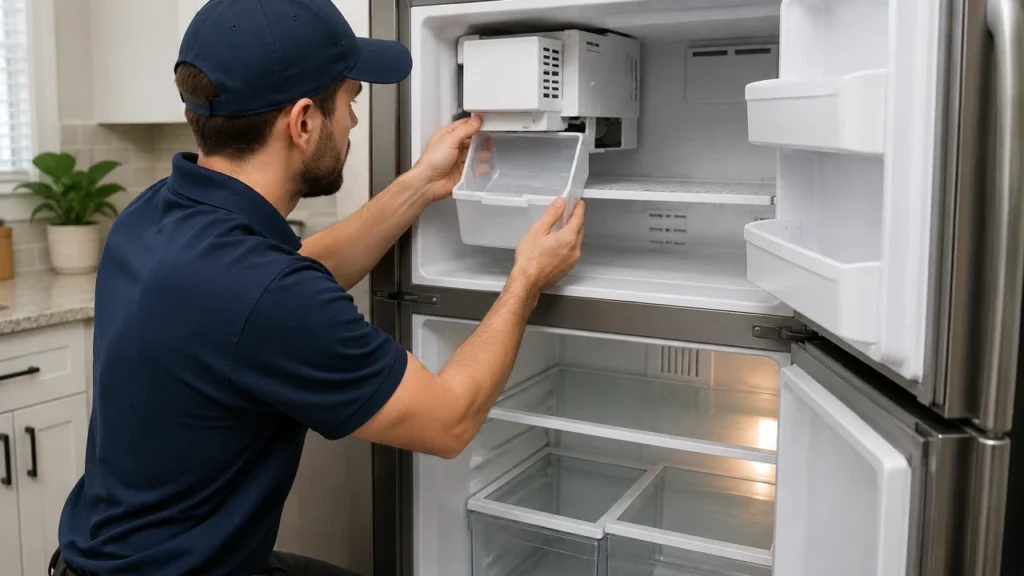
A refrigerator ice maker not working properly can quickly become frustrating, especially during warm weather in Tyler, Texas. You may find an empty ice bucket, unusually small cubes, or a refrigerator that makes noise without producing ice. An ice maker in your fridge that suddenly stops making ice is definitely very inconvenient, especially during hot seasons in Tyler, Texas. You will realize that the ice bucket is not filling up with ice cubes, the cubes are very small or you hear the fridge buzzing but no ice is made.
An ice maker not working for many reasons including something as simple as a mistakenly deactivated function, loose ice bucket, or even lack of water flow. Other times, it could be due to a frozen fill tube, broken water inlet valve, malfunctioning sensor, or other problems within the fridge.
Here are nine things you can do safely before contacting refrigerator repair services in Tyler, TX.
Quick Answer: Why Is My Refrigerator Not Making Ice?
There are a few basic things that can cause your refrigerator ice maker to stop producing ice, which include:
- The ice maker is turned off
- The freezer is too warm
- The doors of the refrigerator and freezer are not closing correctly
- The valve for the water supply is shut
- The water supply line is bent or constricted
- The refrigerator’s water filter needs cleaning or replacement
- There is ice stuck in the ice maker bucket or in the ice maker itself
- The fill tube is frozen
- One of the components within the ice maker has stopped functioning
Most manufacturers’ troubleshooting advice will typically include these points before recommending you call for a service appointment.
Before You Start to Troubleshoot Your Ice Maker
Do not disassemble the refrigerator, tamper with the exposed wiring, or attempt to test high-voltage components.
If you have to check some accessible water supply or ice bucket, read how to do that in the owner’s manual of your refrigerator. Disconnect the refrigerator from electricity prior to performing any tests or touching internal parts of it.
Stop making ice in your appliance immediately and seek professional help in case you observe:
- Water dripping on the floor
- Burning smell
- Melted or damaged wiring
- Tripping of the electricity
- Broken water tubing
- Cooling failure of the refrigerator
- Frost formation on internal parts
In many cases, an ice maker not working properly can be traced to a simple setting, restricted water flow, or incorrect freezer temperature.
1. Check That the Ice Maker Is On
Consider the most obvious cause first: perhaps the ice maker has simply been turned off by mistake.
The ice maker may be activated by:
- A mechanical shutoff arm
- An actual on/off switch
- A button on the refrigerator control panel
- The “Ice Off” function
- The touch screen or app
Look for an “Ice Off” light. In cases where there is a shutoff arm, ensure that it is set to make ice.
Do not attempt to manually adjust a shutoff arm or switch if it seems stuck. Refer to the owner’s manual for details on the right position.
Samsung, for instance, suggests checking if the ice maker is on before attempting any further troubleshooting steps.
2. Verify the Temperature of the Freezer
An ice maker requires a cold environment in the freezer to freeze water and release the completed cubes.
USDA recommends keeping the freezer at 0°F or lower and the refrigerator at 40°F or lower for proper food storage.
It is important to use an appliance thermometer to measure the exact temperature inside the freezer and not the one displayed on the control panel of the device.
The freezer becomes too warm due to:
- Frequent opening of the freezer door
- The door not being shut properly
- Food packaging obstructing the door from shutting
- Blocking air vents
- A dirty or broken freezer door seal
- Power outage to the refrigerator
- Defective refrigerating system
When both the ice maker and freezer seem too warm, then the issue can be related to the refrigeration system of the refrigerator and not the ice maker.
3. Check the Freezer Door and Door Seal
An imperfect seal in the door of the freezer will allow in hot air and will result in the delay in formation of ice, the accumulation of frost, and the inability of the ice maker to go through a full cycle.
Look for:
- Any containers of food that block the closing of the door
- A misaligned drawer or shelf
- Dirty gasket
- Damaged, loose or bent door gasket
- Presence of frost on the ice bucket or the ice maker compartment
- An uneven door
Clean the door gasket with mild soapy water solution using a soft cloth. Avoid sharp objects and aggressive chemicals.
If there are any defects in the gasket or the door looks uneven, the appliance might require adjustment. According to the instructions by Samsung, the ice maker or the freezer compartment that has a poor seal may be too warm to produce ice.
4. Make Sure the Refrigerator Gets Water
The lack of water means that the ice maker won’t have the necessary water to fill up its mold.
Check the water shutoff valve connected to the fridge and make sure that it is fully open. This valve may be found near the kitchen sink, behind the fridge, or somewhere else.
Without moving the fridge, check for any signs of:
- Closed water valve
- Bent or compressed supply line
- Moisture at the connection point
- Broken water tube
- Inadequate water flow from the fridge’s water dispenser
Test your fridge’s water dispenser, if it is present. Low or non-existent water flow from the dispenser can point to an issue with a supply line, filter, valve, or water pressure.
Don’t move the fridge away from the wall if such an action could damage the fridge’s electrical and/or water lines. A broken pressurized water line will leak.
5. Inspect the Refrigerator Water Filter
A clogged or incorrectly installed water filter is a common reason for an ice maker not working as expected. A faulty, old, incorrect, or improperly installed water filter could be preventing water from reaching the ice maker.
See if:
- There is a notification on the refrigerator about replacing the filter
- There is a recent replacement of the filter
- The issue began immediately after replacing the filter
- The filter is properly placed and locked
- The filter is appropriate for the refrigerator model
- There is a weak flow of water at the dispenser
- There are small ice cubes formed
Replace or reinstall the filter in accordance with the manufacturer’s instructions. Do not run the refrigerator without the filter, unless the model allows using the approved bypass plug.
Make the replacements of the filter in accordance with the schedule given in your user’s manual. Water quality and household consumption may influence the restriction of the filter.
According to Samsung and Whirlpool, the water filter/water flow issues may be common causes of insufficient/no ice formation.
6. Inspect the Ice Bucket for a Jam
Sometimes the ice maker makes ice but is unable to drop the ice cubes into or through the ice bucket.
Gently take out the ice bucket using the manufacturer’s guidelines for your refrigerator. Look for:
- Ice cubes that are stuck together
- A big chunk of ice
- A jamming ice scoop or food item
- Frost on the bucket
- Ice stuck near the ice maker outlet
- Incorrectly placed bucket
Pour any loose or stuck ice out in the sink and let the bucket dry.
Never use any sharp objects such as knives, screwdrivers, or hair dryers or boiling water or any forceful method to remove the ice from inside the fridge. This could damage the plastic components, wires, insulation, or the ice maker itself.
Ensure that the ice bucket is fully placed while installing it as some fridges give false reading of an empty or full bucket due to incorrect placement.
7. Check for Frozen Fill Tube
The fill tube supplies water to the ice maker mold. If the fill tube freezes, water will not reach the ice maker, even if the refrigerator is attached to an active water source. If the water dispenser works but the ice maker is not working, a frozen fill tube or faulty inlet valve may be responsible.
Some symptoms include:
- Water dispenser works fine while ice maker stays empty
- No water reaches ice maker mold
- Frost formation in the area where the ice maker is installed
- Ice-making process is repeatedly interrupted
- A buzzing sound comes from the ice maker with no water flowing into it
It is highly undesirable to use any tool on the fill tube and heat it directly. Frozen fill tube can be caused by temperature settings or other factors.
If the fill tube keeps freezing despite all efforts to unblock it, call for help to fix your refrigerator.
8. Check for Installation, Water Filter Replacement, or Power Outage
A new ice maker not working immediately produce ice if there is:
- A recent installation of the refrigerator.
- Restoration of the water supply.
- Replacement of the water filter.
- An empty ice bucket.
- A previous power outage.
- Alteration of freezer temperature.
A period of time is needed for some refrigerators to cool down and start producing the first batch of ice. The manufacturer’s recommendation on the time is required to be followed.
In case of a newly installed water filter, it should be flushed as recommended by the manufacturer.
Make sure the refrigerator cools down normally, the water valve is open, and the doors are closed.
9. Perform Test/Reset as Recommended by Your Model
Some refrigerator models have an ice maker test/reset button. Its position and process is unique from one brand and model to another.
Identify your model and consult the manual for the procedure and perform the test after completing all above procedures. Do not:
- Test repeatedly
- Hold any button other than those recommended in the manual
- Force the ice-maker arm
- Remove electrical covers
- Bypass the door sensor or switch
Repeated testing may result into jamming or even showing extra error codes in some models. The Samsung brand recommends not performing test on ice-maker after the tray is full.
In case the test does not operate, shows extra errors or fails even after a reset procedure, it requires professional analysis.
What If the Ice Maker Produces Ice but Does Not Dispense It?
The issue of the machine not being able to produce ice or dispense it may not be the same thing.
In the case where there is ice in the bucket but none coming out through the door, some reasons may include:
- Dispenser lock is activated
- Ice is clumped in the bucket
- Bucket is placed wrongly
- Chute is blocked
- Switch of the dispenser is broken
- Auger motor is not working
- Door switch of the refrigerator is malfunctioning
It is important to check if the refrigerator is producing ice before looking into the dispenser. When there is ice in the bucket, it is important to check the bucket, chute, lock settings, door switch, and dispenser itself.
Be careful not to place your fingers or any tool in the dispenser.
When Do You Need Ice Maker Repair?
You can ask for ice maker repair services if:
- Your freezer is cool while your ice maker does not make ice
- Your water dispenser functions but your ice mold does not get filled
- Your fill tube keeps freezing
- Your ice maker is leaking or overfilling
- Your ice maker keeps freezing in the bucket
- There is an error code on your fridge
- The test cycle does not run
- Your ice maker is making grinding, clicking, or buzzing noises
- The issue persists even after proper troubleshooting
- Your fridge is not cooling well at the same time
Some internal issues can include water inlet valve, ice-maker motor, control module, temperature sensor, wires, door switch, fill tube heater, or electronic control board.
All these parts need to be diagnosed properly and with service information and safety guidelines.
Information Needed for Your Service Request
Giving more information could make your service request for your appliance easier to process.
These include:
- Brand name of your refrigerator
- Model number of your refrigerator
- Age of your appliance
- If your ice maker makes ice or not
- If your water dispenser is working
- If your freezer is at the right temperature
- Leaks or frosts that you notice
- Any noises that you notice
- Error codes that you notice
- Time when the problem occurred
- Troubleshooting you have done so far
Your model number sticker could be located inside the refrigerator, on an interior wall, near the drawers, or on the door frame. You can review our appliance repair service area in Tyler before submitting a request.
Steps to Help Prevent Future Ice Maker Issues
Proper maintenance of your fridge can help to prevent some of the ice maker disruptions.
The following tips can prove helpful:
- Replace the water filter based on the manufacturer’s directions.
- Ensure that freezer air ducts are not blocked.
- Confirm that the doors are tightly closed.
- Do not store any item in the ice maker bucket.
- Remove old or clumped ice from the machine.
- Clean the bucket as recommended in the user manual.
- Inspect water lines for any moisture.
- Do not continually run the test cycle.
- Resolve any issues with freezer temperature quickly.
In the event of bad taste or smell in the ice, clean the bucket, dispose of old ice, check food stored in the freezer, and inspect the water filter condition.
Having Trouble With Your Ice Maker in Tyler, TX?
Call Tyler Appliance Repair Pro to help you schedule repairs for your refrigerator such as non-working ice makers, water supply problems, frozen fill tube, leakage, refrigerator cooling issues, weird sounds, and dispenser issues. An ice maker not working after basic troubleshooting may require professional diagnosis of the valve, sensor, motor, or control module.
For requesting refrigerator repair in Tyler, TX, contact us at 903-522-5939 or use our online service request form. Tell us the brand name and model number of your refrigerator along with your symptoms and displayed error code. If your ice maker is not working and the problem continues, request refrigerator repair assistance in Tyler, TX.
FAQs
Why is my ice maker suddenly not making ice?
There could be many reasons why your refrigerator has stopped making ice such as an off ice maker switch, freezer temperature being too high, interruption in the water supply, filter blockage, or ice blocking the bucket or fill system. There could even be a failure of an internal ice maker part.
What is the proper temperature of my freezer for the ice maker to operate?
As per USDA guidelines, a freezer temperature of 0°F or lower should be maintained. Freezer temperatures above 0°F could hamper the functioning of the ice maker. An appliance thermometer could help determine the temperature.
Can a dirty water filter affect the ice maker?
A blocked or improperly installed water filter would restrict the water flow to the ice maker. You should check on the filter status, installation and replacement frequency according to the manufacturer guidelines.
Why would the water dispenser work but the ice maker fail?
Some of the problems you might experience are; ice maker not working, frozen fill tube, setting of the ice maker, bucket sensor, water inlet valve, ice-maker module or temperature problems. It is possible to have similar systems but separate failures.
Should I reset my fridge ice maker?
Make sure to follow the specific resetting/test instructions for your particular refrigerator model. First, go through the essential troubleshooting tips for temperature, water, filter, door, and bucket.
Why is my refrigerator producing tiny ice cubes?
Some of the reasons why you get small cubes include: water restriction, low water pressure, filter problem, valve partly closed, and freezing fill tube.
Is it possible to repair an ice maker on my own?
It is absolutely safe to troubleshoot settings, temperature, doors, accessible valve, filter, and ice bucket by yourself. However, electrical issues, internal valves, wiring, control boards, and refrigerant problems require professional service.
Should I reset my fridge ice maker?
Make sure to follow the specific resetting/test instructions for your particular refrigerator model. First, go through the essential troubleshooting tips for temperature, water, filter, door, and bucket.
Why is my refrigerator producing tiny ice cubes?
Some of the reasons why you get small cubes include: water restriction, low water pressure, filter problem, valve partly closed, and freezing fill tube.
Is it possible to repair an ice maker on my own?
It is absolutely safe to troubleshoot settings, temperature, doors, accessible valve, filter, and ice bucket by yourself. However, electrical issues, internal valves, wiring, control boards, and refrigerant problems require professional service.