
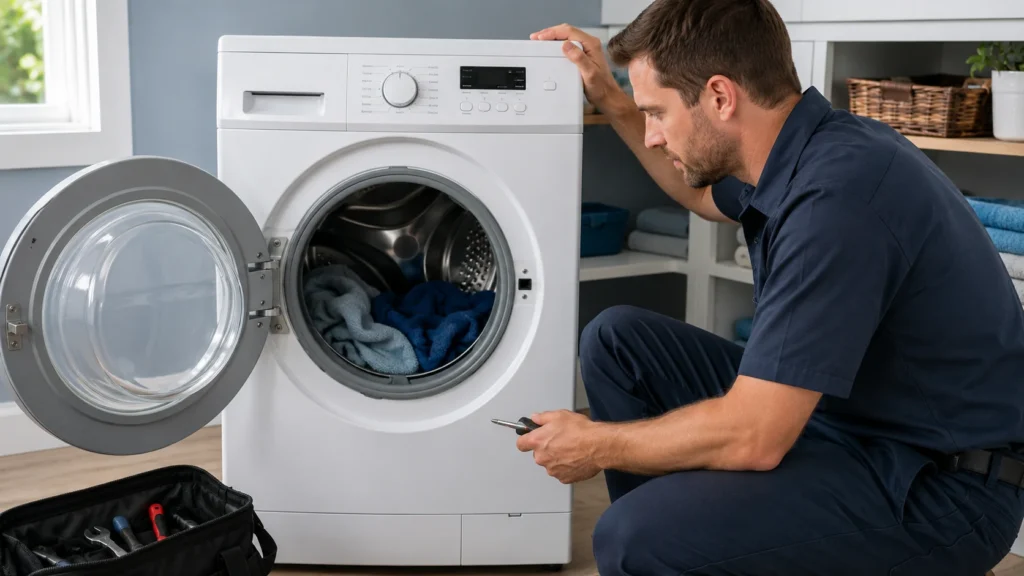
A washer not spinning properly can leave you with soaking-wet clothes, standing water, longer laundry cycles, or a machine that stops before the cycle is complete. Sometimes the washer may attempt to spin but move very slowly. In other cases, the drum may not spin at all.
If your washing machine will wash normally but refuses to complete the spin cycle, the problem does not always mean the appliance has completely failed. An unbalanced load, incorrect cycle setting, drainage problem, door or lid issue, excessive detergent, or an unlevel machine may interfere with normal spinning.
If you are dealing with a washer not spinning in Tyler, TX, start with these eight safe checks before requesting professional washer repair.
Washer Not Spinning? Check These Basics First
A washing machine may fail to spin properly because of:
- An unbalanced laundry load
- Too many clothes inside the washer
- A low-spin or no-spin cycle setting
- Excessive detergent or suds
- Water remaining inside the drum
- A door or lid that is not closing properly
- An unlevel washing machine
- An internal drive, motor, sensor, or control problem
The symptoms can also provide useful clues. Clothes that remain unusually wet, excessive vibration, repeated stopping during the spin cycle, standing water, unusual noises, or an error code may help identify where the problem is coming from.
Before Troubleshooting Your Washing Machine
Start with simple external checks only.
Do not remove electrical panels, bypass safety switches, reach underneath a running washer, or attempt to test internal electrical parts yourself.
Stop using the washing machine and request assistance if you notice:
- A burning or electrical smell
- Smoke
- Sparking
- Water leaking near electrical connections
- Repeated circuit-breaker tripping
- Severe banging or grinding
- A damaged power cord
- A drum that appears loose or badly misaligned
- Water leaking heavily onto the floor
If there is a significant water leak, stop the washer and turn off its accessible water supply when it is safe to do so.
1. Washer Not Spinning Because of an Unbalanced Load
One of the first things to check when a washer will not spin correctly is the load inside the drum.
Whirlpool explains that an unbalanced or overloaded load can reduce spin speed and leave clothes wetter than expected. A washer needs to distribute clothing reasonably evenly before reaching a high spin speed. A single heavy item can collect on one side of the drum and create an imbalance.
Common examples include:
- Blankets
- Comforters
- Bath mats
- Heavy towels
- Jeans
- Large jackets
- A single bulky item
You may notice the washer repeatedly starting and stopping, shaking, moving slowly, or attempting to redistribute the clothing.
Pause the washer according to the manufacturer’s instructions and redistribute the items evenly.
If you are washing one large absorbent item, adding a few appropriate items may sometimes help balance the load. Always follow the load recommendations in your washer’s owner’s manual.
Avoid forcing the washer to continue spinning when it is shaking violently.
2. Washing Machine Not Spinning Due to Overloading
An overloaded washing machine may also struggle to reach normal spin speed.
Packing the drum tightly does not necessarily allow you to finish laundry faster. The clothes need room to move during the wash, rinse, and spin stages.
Signs of an overloaded washer may include:
- Clothes remaining very wet
- Slow spinning
- Excessive shaking
- Longer cycle times
- Repeated attempts to balance the load
- The washer stopping during the spin stage
Remove several items if the drum appears tightly packed.
After redistributing the remaining clothing, select the appropriate cycle and try again.
For future loads, avoid pushing clothing tightly into the drum. Follow the capacity and loading instructions provided for your washer model.
3. Washer Spin Cycle Not Working? Check the Settings
Sometimes the washing machine is working correctly but the selected cycle uses a slower spin speed.
Delicate, hand-wash, gentle, or specialty cycles may intentionally use reduced spin speeds to protect certain fabrics.
Check the control panel for settings such as:
- No Spin
- Low Spin
- Gentle Spin
- Delicate
- Hand Wash
- Rinse Hold
If an unsuitable setting was selected accidentally, choose the correct cycle for the load.
Some machines also have a separate Drain & Spin or Spin Only option that may be useful after correcting an unbalanced load or interrupted cycle.
Do not repeatedly restart the washer if it continues to stop during spinning. Repeated failure usually means another issue needs to be identified.
4. Look for Too Much Detergent or Excessive Suds
Using more detergent does not necessarily produce cleaner clothing.
Too much detergent—especially in a high-efficiency washer—can create excessive suds. Heavy suds may interfere with normal washing, rinsing, draining, or spinning.
Look through the washer door or inside the drum for an unusual amount of foam.
Possible signs of excessive detergent include:
- Large amounts of foam
- Clothes feeling soapy after washing
- Longer cycles
- Poor rinsing
- Repeated rinsing
- Clothes remaining wetter than normal
- Suds-related error messages
If you have a high-efficiency washing machine, use detergent designed for HE appliances and follow the detergent and washer manufacturer’s recommended quantity.
Avoid adding extra detergent simply because clothing is heavily soiled.
If excessive suds appear repeatedly even when you are measuring detergent carefully, check the manufacturer’s instructions for your particular washer.
5. Make Sure the Washer Is Draining Before It Spins
A spin problem and a drainage problem are closely connected.
Many washing machines need to remove most of the water before reaching their full spin speed. If water remains inside the drum, the washer may slow down, stop, or fail to enter the spin stage.
Look for:
- Standing water inside the washer
- A very slow drain
- A drain-related error code
- Gurgling or unusual pump noises
- A bent or pinched drain hose
- Clothes sitting in dirty water
- The cycle stopping before spinning
If you can clearly see standing water, focus on the drainage problem first.
We already have a detailed guide explaining what Tyler homeowners should check when a washing machine is not draining. Use that guide instead of repeatedly running the spin cycle.
Do not open a pump filter without following your washer manufacturer’s instructions. Water may come out when the filter is opened. Samsung also notes that some washers may not enter the spin stage when they cannot drain properly.
If the washer drains normally but still refuses to spin, continue with the checks below.
6. Check the Door or Lid
Modern washing machines use safety systems to prevent normal operation when the door or lid is not properly closed.
Depending on the machine, a problem with the door, lid, latch, lock, or related sensor may prevent the spin cycle from starting.
Check for:
- Clothing trapped in the door
- A door that does not close completely
- A lid that appears misaligned
- A damaged latch
- A door-lock warning
- An error code
- Detergent or debris around the latch area
- A rubber door gasket preventing proper closure
Remove any visible obstruction and close the door normally.
Do not slam the door or force the latch.
You should also never attempt to bypass the door or lid safety switch. If the washer does not recognize that the door is properly closed, the locking system may need professional diagnosis.
7. Check Whether the Washer Is Level
An unlevel washing machine can become unstable during a high-speed spin cycle.
Stand in front of the washer and check whether it appears tilted. With the appliance turned off, see whether it rocks noticeably when gentle pressure is applied to opposite corners.
Also look for:
- One corner sitting higher than another
- A loose leveling foot
- An uneven floor
- Excessive movement during spinning
- The washer repeatedly moving from its original position
- Strong vibration during the spin cycle
The machine should sit firmly on the floor.
Leveling procedures differ between models, so use the washer’s installation or owner’s manual before adjusting its feet.
If the appliance was recently installed, also check the installation instructions carefully. Front-loading washing machines may have shipping hardware that must be removed during installation.
A newly installed washer that shakes violently should be stopped rather than repeatedly operated.
8. Check for Error Codes and Unusual Sounds
Modern washing machines often display an error code when the control system detects a problem.
Do not clear the code immediately.
Write it down or take a photo first. Then check the owner’s manual or manufacturer’s official support information for your exact washer model.
An error code may relate to:
- Load balance
- Drainage
- Door locking
- Motor operation
- Water level
- Speed sensing
- Controls
- Power
Sounds can also provide useful clues.
For example, a washer that makes a loud grinding, scraping, repeated clicking, or heavy banging noise may have a mechanical problem that needs inspection.
A machine that fills and drains normally but never turns the drum may have a different problem from one that begins spinning and then stops.
Avoid repeatedly testing a washer that is making severe mechanical noises.
What If the Washer Spins but Clothes Are Still Soaking Wet?
A washer does not have to stop spinning completely to have a spin-related problem.
If clothing remains unusually wet after every cycle, consider whether:
- The selected spin speed is too low
- The washer is overloaded
- The load is unbalanced
- Too much detergent is being used
- The machine is not draining completely
- The washer is not level
- The spin cycle is being interrupted
- An internal component is preventing normal high-speed spinning
Try an appropriate load using the recommended settings.
If every load remains soaking wet even though the washer appears to complete its cycle, professional diagnosis may be necessary.
Why Does My Washer Stop During the Spin Cycle?
A washing machine that begins spinning and then repeatedly stops may be responding to an imbalance, drainage problem, door-lock issue, error condition, or another detected fault.
Start by checking:
- The laundry load
- The selected cycle
- Whether water remains in the drum
- Whether the door is closing properly
- Any error code shown on the display
If the same problem happens with several different loads, it is less likely to be caused only by one poorly balanced load.
When Should You Request Washer Repair?
Consider requesting washer repair in Tyler, TX when:
- The drum does not spin at all
- Every load finishes soaking wet
- The washer repeatedly stops during spinning
- Standing water remains after the cycle
- The door will not lock
- The machine shakes violently despite being correctly loaded and level
- Grinding, scraping, or heavy banging continues
- A spin-related error code keeps returning
- There is a burning smell
- The circuit breaker repeatedly trips
- Basic troubleshooting does not correct the problem
Internal spin problems may involve components such as the drive system, motor, belt, lid or door-lock assembly, speed sensor, drain system, suspension components, wiring, or electronic controls.
Diagnosing these components may require access to internal parts and electrical testing, so this work is better left to a qualified repair professional.
Information to Include in Your Washer Repair Request
Providing useful details can make your washer repair request easier to review.
Include:
- Washer brand
- Model number
- Approximate appliance age
- Front-load or top-load design
- Whether the drum spins at all
- Whether water remains inside
- Whether clothes remain soaking wet
- Any unusual sounds
- Any leaking
- Any error code
- When the problem started
- Whether it happens with every load
- Troubleshooting you have already tried
If possible, take a photo of the model-number label and any error code before submitting your request.
How to Help Prevent Future Spin Problems
A few everyday habits may help your washing machine operate more smoothly.
Try to:
- Avoid overloading the drum
- Distribute heavy items evenly
- Use the correct cycle for each load
- Select an appropriate spin speed
- Use the recommended amount of detergent
- Use HE detergent when required
- Keep the washer level
- Check pockets before washing clothing
- Pay attention to new vibration or unusual noise
- Address drainage problems promptly
- Follow the maintenance instructions in your owner’s manual
Small changes in loading and detergent use can make a noticeable difference in spin performance.
Need Help With a Washer Not Spinning in Tyler, TX?
Tyler Appliance Repair Pro helps Tyler, TX homeowners request assistance for washing-machine problems including washers that will not spin, drainage concerns, leaks, filling problems, excessive vibration, unusual noises, and cycles that will not finish.
If your washer not spinning problem continues after the safe checks above, professional diagnosis may be needed to determine whether the issue involves the drive system, door or lid lock, drainage system, motor, sensor, suspension, or controls.
For washer repair in Tyler, TX, call Tyler Appliance Repair Pro at 903-522-5939 or submit an online service request.
When contacting us, include the washer brand, model number, whether it is front-loading or top-loading, what happens during the spin cycle, and any error code displayed.
Frequently Asked Questions
Why is my washer washing but not spinning?
An unbalanced or overloaded load, incorrect spin setting, drainage problem, door or lid issue, excessive detergent, or internal washer fault can prevent normal spinning.
Why are my clothes soaking wet after the washer finishes?
The washer may be using a low spin speed, struggling with an unbalanced load, failing to drain completely, or experiencing a problem that prevents it from reaching normal spin speed.
Can an unbalanced load stop a washer from spinning?
Yes. Washing machines may reduce spin speed or interrupt spinning when the load becomes severely unbalanced. Redistribute the clothing and follow the loading recommendations for your washer.
Can a clogged drain cause a washer not to spin?
It can. Many washers need to drain before reaching full spin speed. If water cannot leave the machine properly, the washer may fail to complete the spin stage.
Can too much detergent cause spin problems?
Excessive detergent can create too many suds, which may interfere with normal rinsing, draining, and spinning, particularly in high-efficiency washing machines.
Why does my washer shake during the spin cycle?
An unbalanced load, overloaded drum, unlevel washer, installation issue, or internal suspension problem may cause excessive shaking during spinning.
Should I keep running my washer if it will not spin?
Avoid repeatedly running the machine if it continues to fail, contains standing water, makes severe noises, leaks, smells like it is burning, or displays the same error repeatedly. Have the underlying problem checked first.
When Does a Washer Not Spinning Need Professional Repair?
Request assistance if the washer repeatedly fails to spin after basic checks, leaves every load soaking wet, makes severe noises, leaks, displays recurring error codes, or shows signs of an internal mechanical or electrical problem.