A gas grill not igniting can quickly interrupt plans for an outdoor meal. You may hear the igniter clicking but see no flame, press the ignition button and get no response, or discover that a grill that worked normally before suddenly refuses to start.
Fortunately, a gas grill that will not ignite does not always mean a major component has failed. The cause may be an incorrect lighting sequence, an empty propane cylinder, a weak igniter battery, grease around the ignition area, or debris near the burner openings.
Because propane and natural gas are highly flammable, homeowners should limit troubleshooting to safe visual and operating checks. Never dismantle gas valves, regulators, manifolds, or sealed control components.
Quick Answer: Why Is My Gas Grill Not Igniting?
A gas grill not igniting may be caused by:
- An incorrect lighting sequence
- An empty or disconnected propane cylinder
- A closed fuel-supply valve
- A dead electronic igniter battery
- Dirt or grease around the ignition electrode
- Blocked burner openings
- A damaged igniter, hose, connector, or internal gas component
Start with the safe checks below. If you smell gas, notice a damaged hose, or see a leaking connection, stop using the grill instead of continuing to troubleshoot.
Important Safety Warning Before Checking a Gas Grill
Always inspect and operate a gas grill outdoors in a well-ventilated location.
Before checking accessible components:
- Turn every burner control to OFF.
- Shut off the propane supply when the grill is not being tested.
- Allow the grill to cool completely.
- Keep cigarettes, matches, lighters, candles, and other flames away.
- Never attempt to repair a propane-cylinder valve yourself.
- Never operate a gas grill inside a house, garage, or enclosed area.
Homeowners can review the CPSC gas grill safety guidance for additional information about propane grill hoses, connections, leaks, and safe operation.
If you smell gas while inspecting or attempting to start the grill, do not press the igniter again.
1. Follow the Correct Grill Lighting Sequence
When a gas grill not igniting problem appears, begin by making sure the grill is being started according to the manufacturer’s instructions.
Gas grills do not all use the same lighting sequence. Depending on the model, you may need to:
- Open the grill lid
- Turn on the propane or natural-gas supply
- Select a particular burner first
- Turn the control knob to the ignition position
- Press or hold the ignition button
- Wait for the first burner to ignite before turning on additional burners
Do not assume that the procedure from a previous grill will work with your current model.
Make sure every burner knob starts in the OFF position before beginning the ignition procedure.
Repeatedly pressing the ignition button while gas is being released can allow unburned fuel to accumulate. If the grill does not start, turn the controls off and follow the waiting instructions in the owner’s manual before trying again.
2. Confirm That the Grill Has Fuel
The next thing to check is whether fuel is actually available to the grill.
For a propane grill, confirm that:
- A propane cylinder is connected
- The cylinder is not obviously empty
- The cylinder is positioned upright
- The supply valve is in the operating position specified by the manufacturer
- The connection has not become loose or damaged
- The propane cylinder was connected correctly after its last replacement
If your gas grill not igniting problem started immediately after changing the propane tank, the problem may be related to the connection or the grill’s gas-flow safety system rather than the ignition button itself.
Do not repeatedly disconnect and reconnect propane fittings unless your owner’s manual specifically explains how to do so.
For grills connected to a permanent natural-gas line, avoid adjusting unfamiliar valves or fittings yourself.
3. Check the Electronic Igniter Battery
Many modern gas grills use an electronic ignition system powered by a small replaceable battery.
Press the ignition button and listen carefully.
You may have an igniter-related problem if:
- There is no clicking sound
- The clicking is very weak
- The igniter clicks only occasionally
- The button feels different from normal
- No spark appears where the manual indicates it should
If your grill uses a homeowner-replaceable igniter battery, remove the battery compartment according to the owner’s manual and install the correct replacement.
Make sure the positive and negative ends of the battery are positioned correctly.
You can also look for visible corrosion around accessible battery contacts.
A gas grill not igniting after a long period of storage can sometimes be caused by an exhausted or corroded igniter battery.
Do not dismantle the control panel or ignition module just to reach internal wiring.
4. Look for a Visible Igniter Spark
If the igniter clicks but the burner still does not light, the ignition electrode may not be producing a strong spark in the correct location.
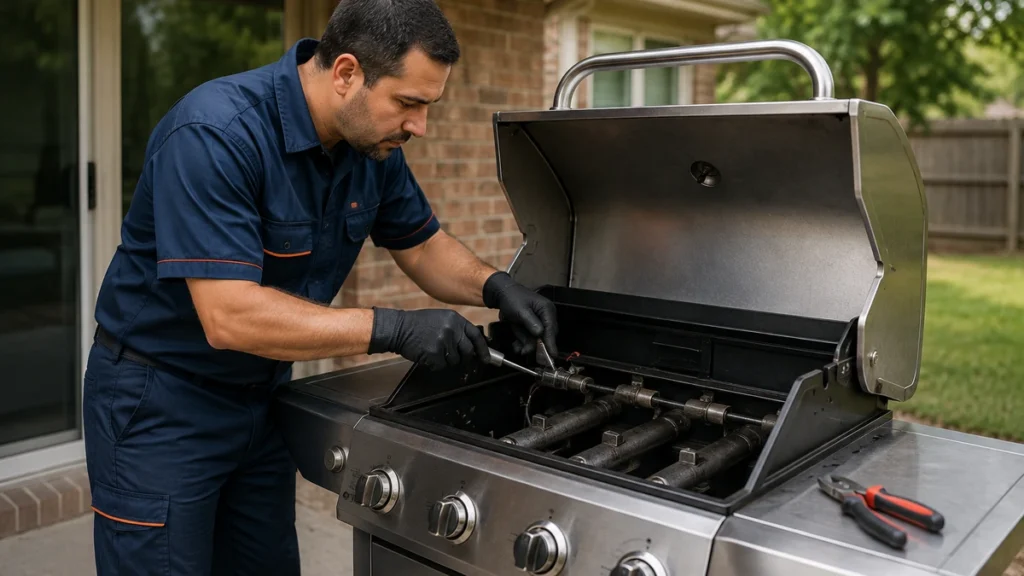
With the gas supply turned OFF and the grill completely cool, visually inspect the accessible ignition area.
Look for:
- Heavy grease buildup
- Food residue
- Moisture
- Corrosion
- A visibly displaced electrode
- Cracked ceramic insulation
- A loose accessible wire
- Dirt surrounding the ignition point
Do not bend or reposition the electrode unless your grill’s manual specifically provides instructions for doing so.
If grease or food residue is visible around a homeowner-accessible ignition area, clean it according to the manufacturer’s instructions.
If the electrode is cracked, severely corroded, or physically damaged, the grill may need further diagnosis.
You can also review Weber’s gas grill ignition guidance for an example of manufacturer troubleshooting related to ignition and fuel-flow problems.
5. Inspect Accessible Burner Openings for Obstructions
A grill that has been stored for several weeks or months can collect debris around burner and air-intake areas.
Possible obstructions include:
- Grease
- Food particles
- Dirt
- Spider webs
- Insects
- Corrosion debris
Before inspecting these areas:
- Turn the gas supply OFF.
- Turn every burner knob OFF.
- Allow the grill to cool completely.
- Remove only components the owner’s manual identifies as homeowner-accessible.
Do not use drills, nails, screwdrivers, or other sharp tools to enlarge burner openings.
The goal is to remove ordinary debris without altering the size or shape of the burner ports.
If a gas grill not igniting problem remains after the accessible burner area has been cleaned correctly, move to the next check instead of repeatedly attempting ignition.
6. Visually Inspect the Hose and Gas Connection
For a propane grill, inspect the accessible hose and connection before attempting to light the grill again.
Look for:
- Cracks
- Brittleness
- Cuts
- Holes
- Melted areas
- Severe bends
- Visible connector damage
- A hose touching a hot grill surface
A damaged gas hose should not be treated as a minor inconvenience.
If You Smell Gas, Stop
If you smell propane or natural gas:
- Do not press the ignition button.
- Do not use a match or lighter.
- Do not smoke nearby.
- Keep other flames and ignition sources away.
- Turn off the gas supply if you can do so safely.
- Do not use the grill until the source of the problem has been identified.
Never attempt to repair a propane tank valve yourself.
If the hose, connector, regulator, or another gas-control component appears damaged, stop using the grill and seek appropriate assistance.
7. Reset the Controls Before One Final Safe Attempt
If you have completed the previous checks and found no gas smell, leaking connection, or visible damage, return the grill to its normal starting condition.
Before trying again:
- Make sure every burner knob is fully OFF.
- Keep the grill lid open.
- Confirm that the fuel source is connected correctly.
- Make sure the igniter battery is installed properly.
- Check that accessible burner areas are clear.
- Confirm that there is no gas odor.
Now follow the exact lighting procedure in your owner’s manual.
If the gas grill not igniting problem continues, do not keep pressing the ignition button repeatedly.
Turn the grill off and stop testing it.
What If the Igniter Clicks but the Burner Does Not Light?
A clicking sound does not necessarily mean the entire ignition system is working correctly.
The spark may be weak, incorrectly positioned, or unable to ignite gas at the burner.
Possible ignition-specific causes include:
- A weak spark
- Spark occurring in the wrong location
- A damaged electrode
- Grease around the electrode
- An ignition-wire problem
- No gas reaching the ignition point
- Debris near the burner
Homeowners should limit troubleshooting to visible and manufacturer-approved checks.
Do not open regulators, gas valves, manifolds, or sealed control assemblies.
What If There Is No Clicking Sound?
If pressing the ignition button produces no clicking sound, start with the simplest electrical checks.
Depending on your grill, the cause may include:
- A dead igniter battery
- Incorrect battery orientation
- Corrosion around the battery terminal
- A damaged ignition button
- A loose accessible ignition lead
- A failed ignition module
If your grill uses a replaceable battery, try a fresh battery of the correct type.
If there is still no clicking after the battery has been replaced correctly, further diagnosis may be necessary.
Do not remove the grill’s control panel unless the owner’s manual specifically identifies the component as homeowner-serviceable.
When Should a Gas Grill Ignition Problem Be Professionally Checked?
A gas grill not igniting should be evaluated further when:
- It repeatedly fails to start after basic checks
- You smell propane or natural gas
- A hose appears cracked, melted, or brittle
- A gas connector appears damaged
- The ignition electrode is cracked
- A new approved battery does not restore the igniter
- Burner components show heavy corrosion
- The grill lights and immediately goes out
- Flames appear where they should not
- You notice an unusual gas-related sound
- The grill has been unused for a long period and has visible deterioration
If the source cannot be identified safely, review the available professional help for barbecue grill problems rather than dismantling the gas or ignition system yourself.
Information to Include in Your Service Request
Providing detailed information can make your service request easier to review.
Include:
- Grill brand
- Model number
- Approximate age
- Propane or natural-gas configuration
- Whether the igniter clicks
- Whether a visible spark appears
- Whether any burner lights
- Whether the propane cylinder was recently changed
- Whether the grill has been stored for a long period
- Any visible hose or connector damage
- Any unusual smell
- When the ignition problem started
Do not continue testing the grill simply to collect more information if you smell gas or see damaged components.
How to Help Prevent Gas Grill Ignition Problems
Basic maintenance can reduce the chance of future ignition problems.
Helpful habits include:
- Keep the grill covered when appropriate
- Follow the manufacturer’s cleaning instructions
- Prevent heavy grease buildup
- Keep accessible burner areas clean
- Inspect the gas hose periodically
- Keep the hose away from hot surfaces
- Replace the electronic igniter battery when necessary
- Keep burner controls fully OFF when the grill is not being used
- Follow the correct lighting sequence every time
- Inspect the grill after long periods of storage
- Stop using the grill when gas odor or visible damage appears
Regular visual inspection is especially useful before using a grill that has been stored for several months.
Need Help With a Gas Grill That Will Not Ignite in Tyler, TX?
If your gas grill not igniting problem continues after these safe checks, do not dismantle gas-control parts or continue making repeated ignition attempts.
Tyler Appliance Repair Pro accepts service requests for barbecue grill ignition concerns. You can submit an online service request and include your grill brand, model number, fuel type, ignition symptoms, and any visible damage.
Before requesting assistance, you can also view the areas we serve.
You can call Tyler Appliance Repair Pro at 903-522-5939 to describe the ignition problem.
Frequently Asked Questions
Why is my gas grill not igniting even though I hear clicking?
The igniter may be producing a weak spark or sparking in the wrong location. Grease around the electrode, burner debris, an ignition-wire problem, or a lack of gas reaching the burner may also prevent ignition.
Why does my gas grill igniter not click?
A dead igniter battery, incorrect battery installation, corrosion, a damaged ignition button, wiring problem, or faulty ignition module may prevent the igniter from clicking.
Can spiders stop a gas grill from lighting?
Yes. Insects, spider webs, dirt, grease, and other debris can collect around burner and air-intake areas and interfere with normal ignition. Clean only the areas identified in the manufacturer’s instructions.
Should I keep trying if the grill does not ignite?
No. Repeated unsuccessful lighting attempts can allow unburned gas to accumulate. Turn the burner controls off and follow the manufacturer’s waiting procedure before attempting ignition again.
What should I do if I smell gas near my grill?
Do not attempt to ignite the grill. Keep flames and cigarettes away, turn off the fuel supply if it can be done safely, and do not use the grill until the source of the gas smell has been identified.
Can I repair a propane tank valve myself?
No. Do not attempt to dismantle or repair a propane-cylinder valve. Problems involving the tank valve, regulator, or other gas-control components should be handled by an appropriate professional.
When should I request barbecue grill service?
Request assistance when the ignition system continues to fail after basic checks, an igniter component appears damaged, the hose or connector is deteriorated, a gas odor is present, or you are not comfortable performing manufacturer-approved checks.